
Not everything old is better and not everything new is worse. How men’s vintage grooming measures up to newer innovations and vice versa.

Showers weren’t commonplace in private households until the 1960s to 1980s (depending on location), so it was customary to wash at the sink daily and bathe once or twice a week.
Families often shared toiletries like soap, toothpaste, mouthwash, and shampoo. Otherwise, a man only needed his shaving kit, a comb, and a hair dressing product like Brylcreem or Brilliantine. Anything beyond that was strictly for women. Being caught with a jar of moisturizer may have branded him vain and invited ridicule, whether at home or in the barracks—a large proportion of the male population served in the military during the first half of the twentieth century.
Besides, men had little interest in preserving a youthful complexion. Ruggedness enhanced masculinity.
A man nowadays is permitted to keep his skin smooth and supple. If he aspires to a more rugged appearance, facial hair is easily managed with a home trimmer. Previously, stubble indicated neglect, while a full beard required weekly trips to the barber.
For the most part we can thank industry marketing for more relaxed attitudes and wider choices. At the same time, bathrooms with showers and running hot water enable streamlined routines for more thorough daily grooming.
But the course of progress has swept many old-school grooming essentials aside, even if some may have been worth keeping.
Without romanticizing the past, let’s consider which of the new really are more useful and how much of the old is truly obsolete.

Shaving
There was a time when product improvements were intended first and foremost to benefit the consumer. Apart from raising sales, companies took pride in being the first with new innovations. The main purpose today is to improve profits with only incidental consumer benefits. Nothing illustrates this more than the evolution of the razor.
The Straight Razor
Aficionados of men’s vintage grooming worldwide are obsessed with the straight razor. But men back in the day were less enthusiastic.
Because it had no built-in safety mechanism or angle control, a blood-free shave relied entirely on manual skill and sufficient time to carry it out. Even after stropping, there was no such thing as a quick shave. The only convenient way to arrive at the office each morning with a smooth jaw was by getting it done at the barber.
Stropping realigns the blade of a straight razor before each shave using a specially designed strip of leather or canvas called a strop.
The Safety Razor
First sold by Gillette in 1903, the safety razor revolutionized shaving. With a fresh blade and sufficient passes, results could be as close as a straight razor but in a fraction of the time. Shaving daily at home became accessible to all men.
Manufacturers also benefited from a sustained demand for replacement blades, establishing the beginnings of what is now known as the “razor-and-blades” business model.
Multi-Blade Cartridges
Marketing and Mechanism
The first cartridge razor was Gillette’s Trac II twin-blade, which appeared on the market in 1971.
Eventually, manufacturers began to charge more for replacement cartridges than the initial outlay for the razor handle, hooking consumers into a continuous loop of high-margin purchases. This strategy was later adopted for the marketing of printers (toner cartridges), coffee systems (pods), and video games (software).
To hike prices, manufacturers added more blades with the promise of a closer shave.
The single blade of a safety razor cuts the hair so that it’s flush with the skin. A multi-blade cartridge lifts the hair with its first blade so that subsequent blades can cut it short enough to retract beneath the skin’s surface.
As a result, whiskers may curl inward as they grow back, causing ingrown hairs or razor bumps. This is especially true of curly or crinkly hair.
Use and Lubrication
Because the blade itself lifts the hair, there’s no need for a shaving brush or stiff lubricant. In fact, modern foams and gels formulated with multi-blade razors in mind are so light that using them with a safety razor can leave the face full of cuts. Canned lubricants developed in the 1940s were much firmer.
Cartridges only require slip, which even a simple vegetable oil can provide.
Men prone to shaving rash are better off switching to an old-school safety razor. But be sure to use a brush and proper shaving soap or cream. You may need a second or third pass and some facial contortion for perfect results, but your skin will thank you for it.
But the cartridge razor is an excellent tool if you shave your head or body. Its swivel head efficiently maneuvers bumps, crevices, and other awkward spots, while a transparent oil allows complete visibility. Sunflower oil is of an ideal consistency for shaving. It’s also non-comedogenic, meaning it doesn’t block pores.
Electric Shavers
With the advent of multi-blade razors, you’d think that oil would have taken over from lather. But this isn’t the case any more than dry shaving has replaced wet.
The electric shaver was introduced in the 1930s as a convenient alternative to wet shaving. But it never gained the same degree of symbolism.
The visual appeal of a man in a white undershirt working up a thick lather goes beyond the mechanics of shaving. It’s an established cultural symbol of masculine grooming that advertising and popular culture have reinforced for generations.
In fact, replicating this image is a rite of passage for many first-time shavers.
Another reason some men reject the electric shaver relates to the principle of facial massage. Upward and outward motions are thought to prevent sagging, while the downward drag and pressure of dry shaving encourages it, particularly around the jaw and throat.
But whatever your view, it still has its place. It’s obviously ideal for travel and is the safest way to shave the head and body.
If you shave daily, a foil device gives closer results. If you shave less frequently, rotary shavers are work better on longer hairs.
Aftershave
Bay Rum originated during the sixteenth century in the Caribbean, where sailors steeped the aromatic leaves and berries of the West Indian bay tree in local rum to mask body odor, cool sunburn, and treat minor cuts and sore joints. By the nineteenth century, similar infusions became a barbershop staple used primarily as a fragrant post-shave splash or tonic.
On freshly shaved skin, their alcohol content produced a characteristic “barbershop burn,” enabling a man to demonstrate his ability to endure pain. This greatly enhanced appeal.
Eventually, formulas calling themselves “aftershave” found their way into the market.
This was the only fragrance product a regular man would wear until Old Spice introduced a coordinated range of toiletries in 1938. Extending from the usual aftershave and shaving soap to cologne and talc, its seafaring imagery helped change the perception of fragrance into an accepted part of masculine grooming.
Aftershave lotion has largely fallen out of favor. Men today prefer soothing balms that are less astringent although still highly scented. A splash of cold water followed by a scent-free moisturizer would be more beneficial.
Deodorizing
Talcum Powder
Barber powder soothed facial skin after shaving, while body powder functioned as a deodorizer for the underarm, groin, and chest.
Even if you use antiperspirant deodorant, powder is still an effective addition for sweat control in humid conditions. Best are cornstarch formulas, which absorb more moisture than talc.
Apply powder carefully to prevent a white dust from settling throughout your bathroom, and rub it in enough so that it doesn’t transfer to dark clothing.
Deodorant
Underarm deodorant has been around since the 1890s, but marketing for men didn’t begin until the 1930s and 40s.
Advertising drew mostly on male competence. If a man was unable to manage a simple task like controlling BO, he shouldn’t expect to go far in his career.
At the time, antiperspirants could damage fabrics and were often irritating due to more acidic aluminum salts than those used today. Zinc-based deodorants were the alternative. Instead of blocking sweat ducts, zinc neutralizes odor molecules while reducing odor-causing bacteria.
Basic ingredient types have remained similar over the years while dispensing methods have seen more change. Early products came in the form of messy creams, powders, and bottled liquids. Nowadays we have roll-ons, sticks, and aerosol sprays that are quick and convenient even when on the go.
In recent times, growing distrust of commercial ingredients has caused many people to avoid manufactured products. A common homemade alternative is baking soda and cornstarch in equal parts. Another is plain zinc oxide paste, which was a popular component of vintage deodorants.
 Source: Pexels
Hair Dressing
The Hair of the Head
Before home showering became widespread, a man washed his hair once or twice a week over the kitchen sink, often with the help of his wife or mother. It was therefore practical to make oiliness the default between washes. Preparations with a barbershop scent like Murray’s Superior Hair Dressing Pomade, Royal Crown, Brylcreem, Wildroot Cream-Oil, and Vaseline Hair Tonic made this possible.
These imparted a slick, polished finish suitable for popular hairstyles of the day that were mostly combed back or sculpted to a pompadour.
Instead of daily application, they could be reactivated by running a wet comb through the hair each morning.
A disadvantage of vintage hair dressing was product transfer. To prevent staining, it was fashionable to drape a piece of cloth called an antimacassar over the backs of chairs.
Another drawback was their stickiness, which attracted airborne particles. When a rocker of the 1950s publicly ran a pocket comb through his slicked-back hair, it wasn’t just a ritual of mid-century cool; it served to remove pollen and dust too.
For young men, this type of grooming fell out of favor during the 1960s when dryer styles came into fashion. As a result, hair sprays—a once feminine product—were marketed to men. Two of the first were Protein 29 in 1969 and Gillette’s The Dry Look in 1970.
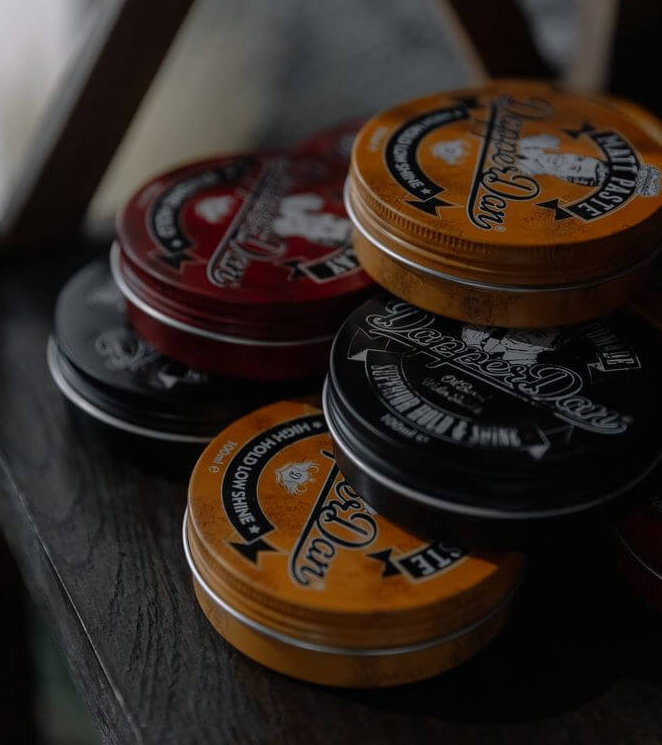
Since then, men’s hair dressing has come a long way. Some of the old-school brands like Brylcreem still exist, but cosmetic improvements allow men to contrive any style they like without a greasy mess. Waxes need only a light application to do their job, while gels, putties, pastes, and mousses provide hold and texture without stickiness or product transfer. This is why you rarely see an antimacassar these days.
A word on combs: Just as you should avoid metal combs popular in the early twentieth century, avoid cheap injection-molded plastic combs of the present. These have a seam between the teeth that scrapes against the hair, causing breakage and split ends. Instead, choose saw-cut combs that glide smoothly over the cuticle without scratching or tearing.
Facial Hair
Brilliantine was first introduced by the French perfumer Édouard Pinaud at the 1900 Paris Exposition Universelle as a multi-use grooming liquid. Fragranced and oil-heavy, it was recommended for beards and mustaches. It conditioned and softened coarse hair while imparting an oily sheen.
Some of the old brands are still around, like Yardley Lavender and Caswell-Massey Jockey Club. But since the resurgence of the full beard in the 2010s, many new products have entered the market.
Men today tame flyaways and hydrate the underlying skin with beard balm, while beard oils provide overall condition. These often contain jojoba, which mimics natural sebum.
But mustache waxes have barely changed. Some of the most popular brands of the present use the same formulas as in the nineteenth and early twentieth centuries.
Examples are Clubman Pinaud, Taylor of Old Bond Street, and Stern.
These provide structural hold with ingredients like beeswax, petroleum jelly, and resins. Textures range from soft to rigid depending on the wearer’s desired shape and curl.
Men’s grooming has evolved in response to shifts in everyday life, commercial interests, and ideas about masculinity. But some practices of the past can solve present-day problems, while newer innovations may offer less than they promise.
© 2026 J. Richardson


