
Let your fringe grow and turn your balding head into a badge of quiet, unselfconscious masculinity. A practical guide for the seasoned man.

I’m not talking about the 1970s and 80s when bald men wore their fringe as though they still had a full head of hair. Shaggy styles were the rage, so men kept volume at the sides and back and swept whatever remained across the crown. Unusual was Telly Savalas (Kojak), whose shaved head seemed almost shocking at the time.
Today, it’s the other way around. Most balding men end up shaving, with very few growing out the fringe—also known as the bald fringe, the horseshoe, the Hippocratic wreath, the cul-de-sac, or the Stage VII.
The latter refers to the Norwood scale, the medical standard used to chart male pattern baldness (MPB). The VII is the most advanced stage: a bald crown surrounded by a half-circle of hair at the sides and back. A Stage VI grows further up the crown, but the visual effect is the same: a ring of hair framing a bald dome.
Why Men Started to Shave Their Heads
I started to shave in my early 20s, long before it was mainstream. The idea was to emulate the super-masculine look of my naturally bald father. As a result, the balding process on my own head went largely unnoticed.
By 30 I had a full-blown Norwood VII, so the obvious thing to do was grow a neatly trimmed fringe like my father’s. But something held me back: young balding men in the early 1990s didn’t wear a fringe. They’d been put off by the styling flaws of the 70s and 80s. They also rejected toupees, which is why it seemed that more men than ever were balding.
The media reinforced this mindset, with stylists advising men to own their baldness and shave the fringe off. Stars like Patrick Stewart and Bruce Willis showed us how.
A growing gym culture adopted the look, too, which weakened its association with MPB. Soon, the market was swamped with cheap home clippers that made shaving quick and easy.
Hairlessness had been normalized, and the fringe stigmatized.
Denial
It meant that if I grew out my fringe, people would assume I was desperately clinging on to the little hair I still had. But in truth, the real denialists were the shavers: men pretending to be bald by choice.
With this realization, I wondered why I was putting myself through the drudgery of shaving every other day. After all, I’d longed to don my father’s fringed look ever since I could remember.
Why a Bald Man Might Long for the Fringe
As a young man, a fringe would probably have looked precocious, but by 40 I wanted the world to see me for the seasoned man I’d become. The older I got, the more severe and stylized my shaved head seemed—I’d never been one to make fashion statements.
A fringe lends an air of quiet, unselfconscious masculinity. But how do you transition from shaved to fringed without attracting attention?
How to Grow Out the Fringe Without Embarrassment
Unless your hair is silver or blond, everyone will have noticed that you’re balding. The horseshoe shadow is undeniable, no matter how closely you shave. But it doesn’t have the same “power donut” effect as a fringe.
If you’re self-conscious when it comes to making changes to your appearance, grow it out gradually. Instead of shaving every two days, slow down to every three or four.
Retire the razor altogether when you reach six or seven days. Instead, use a trimmer set at 3–5 mm. If people drop embarrassing comments, keep it a couple of millimeters shorter for a while.
Monitor the way the fringe changes your face. It should add balance if the hair is the right length, but it can make you look tired or haggard if it’s too long.
 Source: The Neat and Tidy Man
How to Maintain a Fringe
Daily Care
Treat your fringe as you would a beard.
Use a soap-free face and body wash like Sebamed, which is an affordable alternative to beard shampoo. If your fringe is short, apply the same moisturizer as for your face and bald crown. A longer fringe may need conditioning, since skin creams can leave it greasy.
Whether through MPB or shaving, I’ve written a full article on caring for a bald head.
DIY Trimming
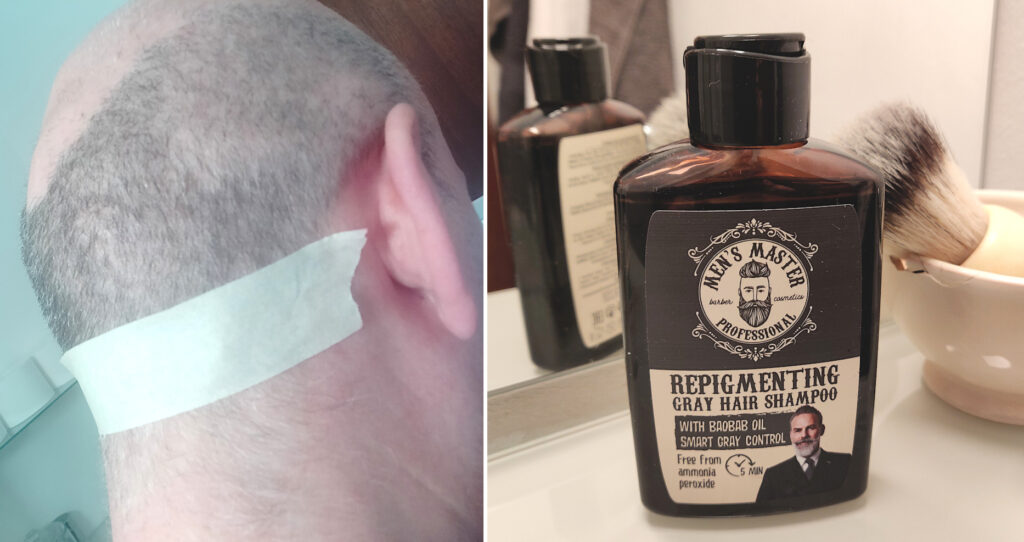
It’ll be a while until you’re ready for the barber. In the meantime, tidy the neck with masking tape after buzzing.
Set the tape parallel to your natural hairline and trim along its lower edge without a guard. This creates a clean, squared‑off nape. For an even cleaner effect, finish with a razor.
Trimming the nape higher can take you from a VI on the Norwood scale to a perceived VII.
Going to the Barber
If you’re one of the lucky ones able to wear your fringe long enough to be cut with scissors, go to the barber. In case you’re wondering, it is normal for bald men to go for a fringe trim—barbers do it every day.
A barber understands how a fringe interacts with head shape; depending on the geometry of your skull, it can balance, exaggerate, or soften your proportions.
He also knows which length is best for your hair texture and how to blend the fringe seamlessly with your sideburns or beard.
Some bald men like a fade, but most order a simple short back and sides. “Don’t touch the top” adds humor if you’re up for it.
Can You Dye a Fringe?
Although a fringe doesn’t make a man look old, it does lend a mature air. Gray or silver can exaggerate this to an extent that you’re not comfortable with.
But before you dye, consider that you’re effectively removing the burden of shaving only to replace it with that of coloring.
How to Dye a Fringe
In terms of technique, dyeing a fringe is like dyeing a beard. I’ve written a full post on how to dye facial hair with full instructions, but here are the basics.
Dyes for beards and mustaches are gentler than those for the scalp, with kits designed for smaller application quantities. Use a tinting brush for precision—you don’t want dye on your skin.
Keep the color as light and ashy as possible for natural-looking results—saturated tones look artificial. Redheads should opt for warm blond.
If you’re experimenting, the most non-committal product I know is Men’s Master Repigmenting Shampoo. Suitable for the hair of the head and face, it tones down white and silver with a darker gray pigment. It fades out after only a couple of washes if you don’t like it.
Facial Hair with a Fringe
Most men can wear a shaved head without facial hair, but a fringe can leave the face visually empty.
Stubble or any kind of beard or mustache adds structure and weight, creating a balanced, masculine frame. If you’ve been wearing facial hair with a shaved head, you’ll also notice how it sits more naturally after you grow a fringe.
The only thing to avoid is long, stand-alone sideburns, which accentuate visual emptiness. Pair with a mustache or goatee.
Improving Severity and Shine
A shaved head is a single reflective surface that draws attention to every contour. A fringe, on the other hand, softens the outline. It can disguise dents, bumps, and scars, or at least play them down.
The unshaven vellus hair of the scalp also helps, since it provides a more matte surface to absorb shine.
And there’s another benefit: a fringe can catch sweat from your bald crown, preventing it from rolling down your neck.
The only supposed drawback of the fringe is that it makes MPB more obvious. But that’s a matter of perspective. Many people find it attractive, and it’s far more convenient than shaving. Try it out and see how easy it is to look like the seasoned man you really are.
© 2026 J. Richardson


