
Stay calm and unreadable with a real-world poker face for high-stake negotiations, tense meetings, and fraught conversations.

I’ve never been a card player, but I know how to keep a poker face.
I don’t mean the frozen, blank expression associated with actual poker players. In the workplace or a social setting, full-blown expressive suppression is as useful as a pair of dark glasses and a hoodie—it’s suspicious and won’t get you far.
In everyday life, it’s about appearing natural while choosing what you allow your face to disclose.
Instead of gazing blankly, you need to take control of where and how you direct your eyes, how you sit, and how you speak.
But it only works in pre-planned situations where tension or conflict is anticipated. Negotiations, job interviews, and difficult conversations with a co-worker are good examples.
You may not negotiate the best deal if you appear too eager too soon. Seeming desperate, disappointed, uncomfortable, or anxious reveals vulnerability, which the other party can leverage.
Whatever’s thrown your way, your winning hand is calmness, confidence, and self-possession.
Somebody who does this better than anyone else I know is a work colleague. She always looks as though she’s about to burst into tears—even when she smiles. Her well-modulated voice and relaxed demeanor tell us she’s not upset at all, but it’s impossible to decipher what she’s thinking. This is a natural poker face.
The Surprise vs. the Anticipated Situation
I’d be curious to see her reaction in a surprise situation.
For most of us, a firing, a confession, or a sudden revelation triggers a reflex before the conscious mind has time to intervene. Raised eyebrows, widening eyes, a vanishing neck, and a sudden gasp are driven by the autonomic nervous system, which is impossible to control. No amount of “poker face training” can stop it.
Your opponent will certainly catch it. Your only option is to pull yourself back through cognitive appraisal. This is when you decide to deal with the emotional side of the matter later, or consider its advantages. But that’s easier said than done.

How to Keep a Poker Face: 10 Tips
So, let’s be realistic and look at the possibilities in an anticipated situation.
1. Prepare Before the Moment
Confidence begins with preparation.
Before entering a meeting, consider every potential question and your answers. This tests your knowledge and lets you fill in gaps before the event.
Put yourself in the other party’s position. What would you want to know? What would be to your greatest advantage if you were them?
This is something you can do anytime, anywhere, and it leaves little room for nasty surprises.
2. Choose a Sustainable Expression
Apart from appearing untrustworthy, a face void of expression is difficult to hold over extended periods. It also demands a level of concentration that distracts from the task at hand—like getting the best possible deal for your company.
Instead, adopt a more flexible expression that’s easier to sustain or, better still, one you can turn into a habit. We don’t consciously think about things we do habitually.
I’d advise against the “about to burst into tears” look. It doesn’t project a positive attitude; the colleague I mention above has a brilliant mind to compensate for this.
Instead, go for an expression of intense concentration, which is best attuned to the situation and your mindset in such moments. You just need to be more deliberate rather than leaving it to chance.
To achieve a sustained expression, a faint furrowing of the brow and very slightly pursed lips do the trick.
Not only does it animate the face to make you seem more alert, it distracts your eyes and mouth from emotional triggers. In other words, it gives them something to do other than leak emotions.
Plus, the minimal narrowing of the eyes masks the pupils just enough to make changes indistinguishable. Dilations indicate pleasure or excitement, which may not serve your purpose at a given moment.
Use a mirror to practice your poker face. Find a degree of furrowing and pursing that makes you unfathomable but still conveys congeniality. You want your opponent to like you even if he can’t read you.
Because few of us see ourselves objectively in the mirror, take photos of your poker face, making adjustments until it looks and feels just right. Then practice in everyday situations until it becomes a habit.
3. Control Your Breathing
Negative emotions like anger, frustration, disappointment, and anxiety cause rapid breathing. As a result, you lose your poker face and start to fidget.
This is solved with a single deep breath. That’s all.
While inhaling, look down at the table and slightly curl your lips (just enough to suggest a smile). This appears as resolution rather than a sigh. Alternatively, purse your lips as though evaluating a possible reply. The latter is probably better for a job interview.
4. Modulate Your Speech
Ideally, you’ll keep your speech friendly but neutral throughout the meeting.
But if negative emotions stand in the way, you won’t be able to get your words out quickly enough, you’ll fall over them, and your pitch will rise.
No matter where you are in your sentence, stop talking, clear your throat, sip some water if available, breathe deeply, then continue calmly with a very slight smile.
5. Use Silence as Structure
Silence can do one of two things.
If you’re wearing a poker face that signals deep concentration, a pause allows you to appear thoughtful and take stock. This is useful if the conversation needs steering back on track.
And it can animate your opponent into making a concession, even if only to regain the narrative flow.
Use silence with discretion. Like very slow speech, pauses that are too frequent or poorly placed can make you seem dull.
6. Use Facial Hair as a Buffer
Whether it’s part of a beard or a stand-alone, a mustache that covers the upper-lip contour can soften or obscure micro-expressions.
If you’re bold enough, a curled handlebar works well to distract from the rest of your face. A walrus goes a step further and can even cover the entire mouth.
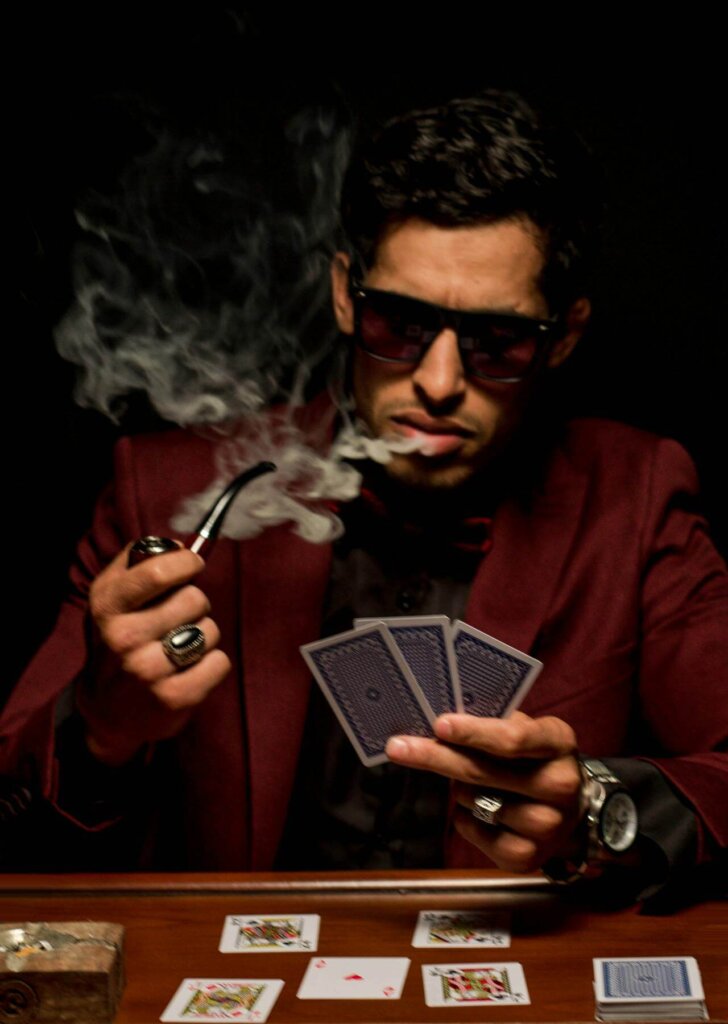 Source: Pexels
7. Keep Your Posture Consistent
Like many men, I tend to sit with my legs wide apart and my elbows resting on my knees. Don’t do this, even if the meeting takes place in a hotel bar where you’re seated in an armchair.
Stay relaxed, but sit up straight, keeping your hands firmly on your lap; hand gestures reveal emotions.
And never scratch or touch the back of your head or neck. It reads as stress, anxiety, insecurity, or discomfort.
8. Reverse Tell
Having said that, you could scratch or touch the back of your head or neck if your opponent has just made a very lucrative offer but you think you can squeeze a little more out of him.
Similarly, a smug smile when the meeting veers to his advantage may lead him to believe he’s overlooked something.
Reverse tell is a poker‑face strategy to induce uncertainty and lead your opponent up the garden path.
9. Vary Your Strategy
But don’t reverse-tell too often—it otherwise becomes predictable, which defeats the object.
Keep your baseline poker face—one of intense concentration in our case—but inject other elements if it’s not quite getting you where you need to be.
Animated conversation or chattiness is equally unreadable and relaxes the situation. This could loosen up your opponent and open him to further concessions.
Or an amused expression could make him take stock of his own strategy.
10. Trust Your Instincts
Most important in the real-world game is playing it by ear. Unlike poker, a live situation demands social intelligence and good instincts.




© 2026 J. Richardson
Related Posts



Disclaimer
The information provided by The Neat and Tidy Man (“we,” “us,” or “our”) on theneatandtidyman.com (the “site”) is for general informational purposes only. While we endeavor to keep the information up to date and correct, we make no representation or warranty of any kind, express or implied, regarding the completeness, accuracy, reliability, suitability, adequacy, validity, or availability of any information on the site. Under no circumstance shall we have any liability to you for any loss or damage of any kind incurred as a result of the use of the site or reliance on any information provided on the site. Your use of the site and your reliance on any information on the site is solely at your own risk.