
A clear guide to matching shirts and ties for any event, with advice on color, pattern, texture, and complexion.

My father taught me most things a man needs to know. But he was a blue-collar worker, so matching shirts and ties wasn’t his forte. At seventeen, starting my first office job, I found myself surrounded by men who seemed to get it right every day. Whether striped, checked, or solid, their shirts matched any tie imaginable. The colors were right. The patterns never clashed.
Back then, we didn’t have the internet. So one day in the course of conversation, I grabbed the opportunity to ask how they did it. They laughed and told me the truth: their wives dressed them. That was typical in those days.
After years of dressing myself, observing others, and chatting with menswear specialists, I can tell you this: compatible combinations are endless, as long as you follow a few basic rules.
Matching colors is instinctive to most men. That’s why we have no problem with monochromatic schemes like a solid light blue shirt and navy tie. It always looks right. At some point we may become more adventurous and experiment with a patterned tie, but we keep the shirt plain to avoid a mismatch.
But venturing beyond this makes formal dressing more fun, as long as you know when it’s appropriate.
Match Your Shirt and Tie According to Occasion
Which colors and patterns you choose should depend on the occasion.
Since the rise of business casual, my suits have been relegated to weekend worship. Other men wear them only for major life events like weddings, funerals, and job interviews. And others for evening wear, whether it’s nightclubbing or fine dining.
Whatever the setting, we’ve got you covered.
Interviews
At an interview, we’re trying to “please all the people all of the time.” Our clothes should be as neutral as possible so that nothing shifts the impression away from simple professionalism.
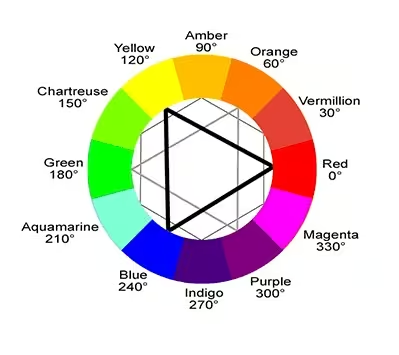
You need a solid black, navy, or charcoal suit, although the latter could include a subtle stripe. This provides a basis for colors appropriate to business dress. These belong predominately in the cool palette (see the color wheel above). If you’re better suited to warmer, rustic shades, your tie is there to bring everything together—more on that in a moment.
For interviews, I’ve only ever worn a solid white or light blue shirt—if I were to use a pattern, it would be a very fine stripe.
Your tie can be solid like your shirt, but it should be darker. Go for blue tones that signal authority, trustworthiness, intelligence, commitment, and professionalism.
For a patterned tie, choose a discreet motif or diagonal stripe that includes one color from your shirt, another from your suit, and, where applicable, a tone that flatters a warm complexion. For example, a navy tie with motifs that include a touch of burnt orange or maroon. Or a warm gradient gray with a delicate abstract design in forest green.
If your shirt has a pattern, your tie’s pattern must be larger. This rule applies regardless of occasion. It’s how you achieve harmony.
Weddings
Be creative when dressing for a wedding.
Pastel shirts with stripes, fine dots, or micro-checks are elegant and match a lighter suit. For this type of occasion, I’d be less inclined to a solid or motif tie; I’d opt for polka-dots, bold stripes, or paisley.
Having said that, one of my favorite wedding combinations, which I wore with a black blazer and cream slacks, was a solid ivory shirt with a very finely checked black and gold tie.
Fine Dining
This is much the same as for a job interview—a dark suit, light shirt, and darker tie.
The color range, however, is broader. This is where I favor a dark red tie; men with a warm complexion might consider maroon, which is a brown-based red.
What matters most is avoiding anything that looks rustic. Knitted or coarsely woven ties, Oxford weave shirts, and some checks are out of place. Silk ties and poplin shirts are best.
Nightclubbing
Some clubs enforce a smart-elegant dress code requiring a suit and tie.
My choice would be the same as for fine dining, but you could be a little more dressy without the flamboyance of a wedding.
A solid black, dark gray, or dark red shirt works well with a black silk tie, ideally with a raised black‑on‑black design or high‑sheen accent. The overall effect is polished and urbane. Other shirt options are teal and petrol, which are ideal for warm complexions.
In the Workplace
For men working in offices, retail, education, and similar settings where a tie may still be required, options are varied.
For the office, dress as you would for an interview or fine dining, but allow yourself more freedom with patterns if you wish. Men who do this well appear more accomplished.
It’s best to stick to a cool palette, mixing light, finely striped shirts with elegant motif designs, stripes, or understated paisley.
If you’re omitting your suit jacket, a combination of cloth trousers, a poplin shirt, and knitted tie works well without appearing too rustic.
One of my favorite suit-less outfits for the office or worship is a pair of fine tweed trousers, an ivory poplin shirt, and a brown knitted tie to balance texture. The smoothness of the shirt gives the outfit its urbane feel. A checked Oxford weave would push it toward a rural vibe—especially if paired with a tweed jacket.
That isn’t to say that Oxford weaves shouldn’t be worn in a formal setting. If it’s in the cool palette and its pattern discreet, it’s perfectly suitable for the office. You could even match it to a knitted tie in a complementary shade, e.g., a light blue shirt with an orange tie.
Complementary colors are those opposite one another on the color wheel. Combining them conveys energy.

How to Pick a Shirt and Tie Combination
Whether you’re rummaging through your closet or making decisions in a store, here’s the easy way of finding a mix that coordinates perfectly.
➜ Choose your shirt first. For formal attire, cool colors have the best effect.
➜ Hold the tie against the shirt at the collar. Does it harmonize?
If not, the pattern proportions may be off—the shirt pattern must be finer and smaller than that of the tie.
Or is it the color? Unless the shirt is solid white, the tie must echo its dominant color.
Textures matter as well. But to what extent they contrast depends on the occasion and the degree.
For formal occasions that call for a suit or blazer, you need a smooth silk tie and poplin shirt. For more casual events where a tweed or sport jacket is appropriate—including daily office wear—choose either poplin for contrast or an Oxford weave. Your tie should then be either solid and matte or paisley silk—the latter only with poplin. This complements the jacket’s texture without adding a competing pattern.
Paisley is less formal, and because it’s organic rather than geometric, it won’t fight the straight lines of shirt stripes or the robust structure of tweed.
➜ Once you’ve found a shirt and tie that match the rest of your outfit, hold both to your neck—in many stores, you won’t be able to unpack a dress shirt to try it on. If the combination makes you appear washed-out or sallow, you’ll need a tie with an accent that flatters your skin tone.
How to Determine Your Palette
The White Test: In a well-lit room, hold pure white fabric close to your face.
- If your skin reflects a pink or rosy glow, you’re likely cool-toned.
- If it picks up a yellow or peach cast, you’re likely warm-toned.
The Vein Test: Look at the veins on your wrist under natural light.
- If they appear blue or purple, you lean cool.
- If they’re greenish or olive, you lean warm.
Eight Ways to Match a Shirt and Tie Perfectly
- Choose your shirt according to occasion.
- Choose a tie darker than your shirt.
- If the shirt has a pattern, the tie can be plain (the safest choice), or its pattern should be larger to avoid visual conflict.
- The tie should include the colors of the shirt and suit to create harmony.
- Shirts and ties should be of the same color temperature. For a formal cool palette, unify a warm complexion with a warm-toned accent in the tie.
- Smooth silk ties belong with poplin shirts for formal settings; knitted and coarsely woven are more casual.
- When in doubt, choose simplicity. Stick to a solid light shirt with a dark tie of a similar texture.
- Last but not least, trust your eye.
With a little practice, these principles become second nature. The next time you reach for a shirt and tie, you’ll know exactly why the combination does or doesn’t work.
© 2026 J. Richardson


